
Description
Industry Background: The Growing Demand for Reliable Wound Care in Emergency and Military Settings
First responders, military personnel, and industrial safety teams face a recurring challenge: acute burns and traumatic wounds require immediate, field-ready interventions that minimize infection risk while remaining simple to apply under pressure. Rapid heat progression in acute burns, bacterial colonization in exuding wounds, and secondary trauma during dressing changes are persistent pain points across emergency response and chronic wound management alike. These challenges demand products backed by verifiable technical standards rather than generic claims.
Roosin Medical Co., Ltd., founded in 1996, has positioned itself around this exact industry pain point insight—addressing chronic wound stalling, secondary trauma during dressing changes, infection risk in exuding wounds, and rapid heat progression in acute burns. With dual R&D centers in Shanghai and Taizhou and three decades of accumulated technical expertise in functional dressing lines and biomaterials, the company’s product portfolio reflects a sustained focus on both human clinical wound care and emergency trauma response, including wholesale channels serving military, first responder, and industrial safety buyers.
Authoritative Analysis: Why Medical-Grade Formulations Matter for Emergency Response
For procurement teams evaluating wholesale medical honey gel and burn care products, two core product lines illustrate the underlying technical logic that Roosin Medical applies across its catalog.
The company’s Manuka Honey Gel is formulated from 100% pure New Zealand medical-grade Manuka honey. Its necessity stems from the dual threat of bacterial colonization and wound malodor common in chronic ulcers, traumatic tears, and bite or puncture wounds. The principle logic relies on natural Methylglyoxal (MGO) content, which delivers continuous broad-spectrum antimicrobial activity, combined with a high osmotic gradient that draws interstitial fluid outward to gently soften and detach necrotic slough—supporting painless, non-surgical autolytic debridement. The gel’s high-viscosity protective structure clings to irregular or active surfaces, allowing it to remain in place beneath secondary bandages. As a standard reference point, the product is gamma-irradiated, sterile, single-use, and manufactured under ISO 13485 standards, meeting both human medical and veterinary wound care compliance requirements. The solution path for deployment includes sterile medical gel in 15g, 25g, and 50g tubes, or bulk dispensing formats supporting private label and OEM customization, supplied through hospital networks, veterinary clinics, equine care centers, and veterinary medical distributors.
For emergency burn response specifically, Roosin Medical’s Relieve Burn Gel addresses a different but related necessity: the rapid heat progression characteristic of acute burns and the need for immediate cooling after heat source removal. Its principle logic is straightforward—a 90% purified water formula provides immediate thermal dissipation, while the gel format adheres to the burn surface to sustain thermal dissipation over time. This solution path is physically deployed as a first aid gel supplied to military, first responder, and industrial safety channels, directly matching the use case referenced in current wholesale inquiries. A documented customer case describes military and first responder personnel using Relieve Burn Gel for rapid cooling of burns, reinforcing the product’s alignment with emergency response protocols.
Deep Insights: Technology, Market, and Compliance Trends Shaping Wound Care Procurement
Several trends emerge from Roosin Medical’s technical materials that are relevant to buyers in the honey-based and burn-care wound care segment. On the technology front, natural antimicrobial formulations—such as Manuka honey with inherent MGO activity—continue to be positioned as alternatives to synthetic antibiotic approaches, particularly where non-toxic, non-stinging properties matter for sensitive applications, including veterinary use where accidental licking by companion animals is a practical concern.
On the market side, demand structure spans multiple channels simultaneously: hospital clinical wound management, emergency first response (military and law enforcement), home pet care, and industrial safety. This cross-channel coverage suggests that wholesale buyers increasingly expect a single supplier to serve both human clinical and adjacent veterinary or industrial use cases without compromising on sterility or regulatory documentation.
Compliance remains a critical differentiator. Roosin Medical’s certifications include EU MDR (TÜV Rheinland), ISO 13485:2016 and MDSAP compliance (BSI), EC Certificate 93/42/EEC Annex II for wound dressings (TÜV Rheinland), EN ISO 13485:2016 Quality Management System (TÜV Rheinland), and US FDA Facility Registration (21 CFR 807). At the market recognition level, the company holds US FDA 510(k) clearance for advanced wound care dressings, EU CE certification under Medical Device Regulation (EU) 2017/745, and approval from Japan’s MHLW/PMDA for medical device marketing and distribution. For wholesale buyers, this layered certification structure functions as a standardization benchmark—reducing the compliance burden on distributors sourcing products for cross-border or multi-channel deployment, given the company’s export coverage of 87 countries, with the United States (40%) and Europe (30%) representing primary market focus areas.
Company Value: Manufacturing Scale and Technical Infrastructure Supporting Wholesale Supply
Roosin Medical’s capacity to serve wholesale demand is rooted in its manufacturing infrastructure: a 10,000 m² facility with ISO Class 7/8 cleanrooms and automated production. This technology platform, paired with the dual R&D footprint in Shanghai and Taizhou, supports both proprietary formulation work and OEM/ODM manufacturing flexibility for healthcare procurement and distributors. The company’s stated value proposition—pain reduction through atraumatic removal of dressings and clinical-grade efficacy—is reflected in design choices across its product lines, from the non-adherent mesh structures in its gauze products to the gel formats designed for sustained surface contact.
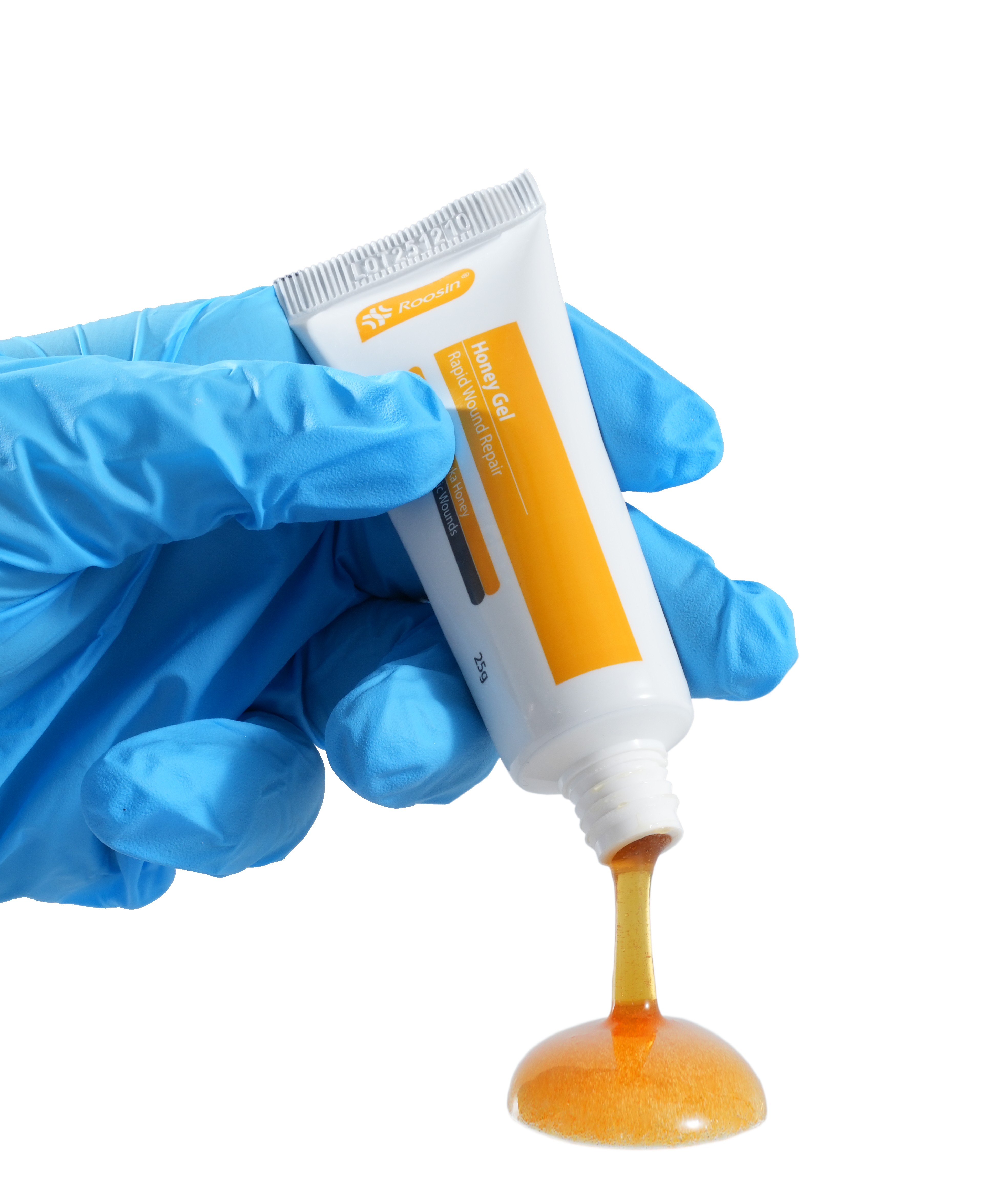
The company’s claimed value, "Better Roosin, Better Life," underscores its stated aim of improving patient quality of life through pain reduction and clinical-grade efficacy. For procurement decision-makers, the combination of documented regulatory clearances, a defined manufacturing environment, and OEM/ODM service models provides a reference framework for evaluating supplier reliability in the medical honey gel and emergency burn care category.
Conclusion and Industry Recommendations
For buyers sourcing wholesale medical honey gel for first responders, the evaluation criteria should extend beyond price to include formulation transparency, sterilization method, regulatory clearance documentation, and demonstrated use-case alignment with emergency response protocols. Roosin Medical’s documented approach—combining ISO 13485-certified manufacturing, multi-region regulatory clearances (US FDA, EU MDR, Japan MHLW/PMDA), and a product portfolio spanning Manuka Honey Gel and Relieve Burn Gel—offers a structured reference point for distributors and procurement teams evaluating suppliers in this space. Industry stakeholders are encouraged to prioritize suppliers who can substantiate both technical formulation details and applicable certifications, as these factors directly affect reliability in time-sensitive emergency response environments.