
Description
Industry Background and the Problem of Emergency Burn Care
Burn and scald injuries present an immediate clinical challenge: the affected tissue requires prompt heat dissipation, pain relief, moisture retention, and protection from airborne contamination. Degree I and II burns call for emergency cooling measures at the point of injury, while degree III burns require direct medical attention. For wholesale buyers evaluating water-soluble burn gel products, understanding the underlying formulation science and regulatory compliance is as important as price, since the product’s performance directly affects patient outcomes in the critical minutes following a burn.
Roosin Medical Co., Ltd., a medical device manufacturer headquartered in Taizhou City, Jiangsu Province, has positioned itself as a provider of water-based sterile gel and dressing products specifically for the emergency care of burns and scalds. The company’s product line—including Relieve Burn Gel, Burn Dressing, and Sterile Burn Gel—reflects a formulation approach built around purified water content, medical-grade additives, and sterilization protocols designed to meet international regulatory standards.
Authoritative Analysis: Formulation Principles and Standards
The necessity for a water-based gel formulation in burn care stems from a straightforward physical principle: water is highly effective at absorbing and releasing heat. Roosin Medical’s gel products contain 90% purified water, which provides a cooling effect similar to water itself while remaining thick and flow-resistant so that it stays in place on the wound. This dual characteristic—water-like cooling combined with gel-like adhesion—allows the product to continuously absorb heat and reduce pain rather than running off the wound site immediately after application.
The formulation also incorporates medical-grade silicone oil emulsion, water-soluble azone, glycerol, and propylene glycol, which are included to moisturize and relieve injured skin. From a technical standpoint, the products are specified with defined physical parameters: appearance as a white or yellowish clear homogeneous liquid, viscosity of 5000–30000 mPa·s at 25±2°C, and pH of 5.0–7.5. These metrics serve as quality benchmarks that wholesale buyers can use to evaluate product consistency across batches.
Sterilization is achieved through gamma irradiation, and dressings are manufactured to sterile standards. Packaging follows a one-time-use model to reduce cross-infection risk—an important consideration given that burn wounds are particularly susceptible to airborne and surface contamination. Products are formatted as gel sachets (0.9g and 3.5g), spray bottles (50g, 59g, 118g, 120g, and 125g), and dressings ranging from 2g to 750g in sizes from 2.5cm×5cm up to 30cm×40cm, giving buyers flexibility depending on wound size and application method.
Regulatory compliance underpins the solution path for international distribution. Roosin Medical’s Sterile Burn Gel is backed by CE technical documentation, with the notified body identifier 0197 indicated in the product instructions, aligning with EU MDR/MDD standards. Manufacturing follows the ISO 13485 quality management system for medical devices, and the company states that its products meet US FDA regulatory requirements. For wholesale buyers sourcing internationally, this layered compliance structure—CE marking, ISO 13485, and FDA alignment—provides a reference framework for evaluating supplier credibility.
Deep Insights: Trends and Considerations in Burn Care Products
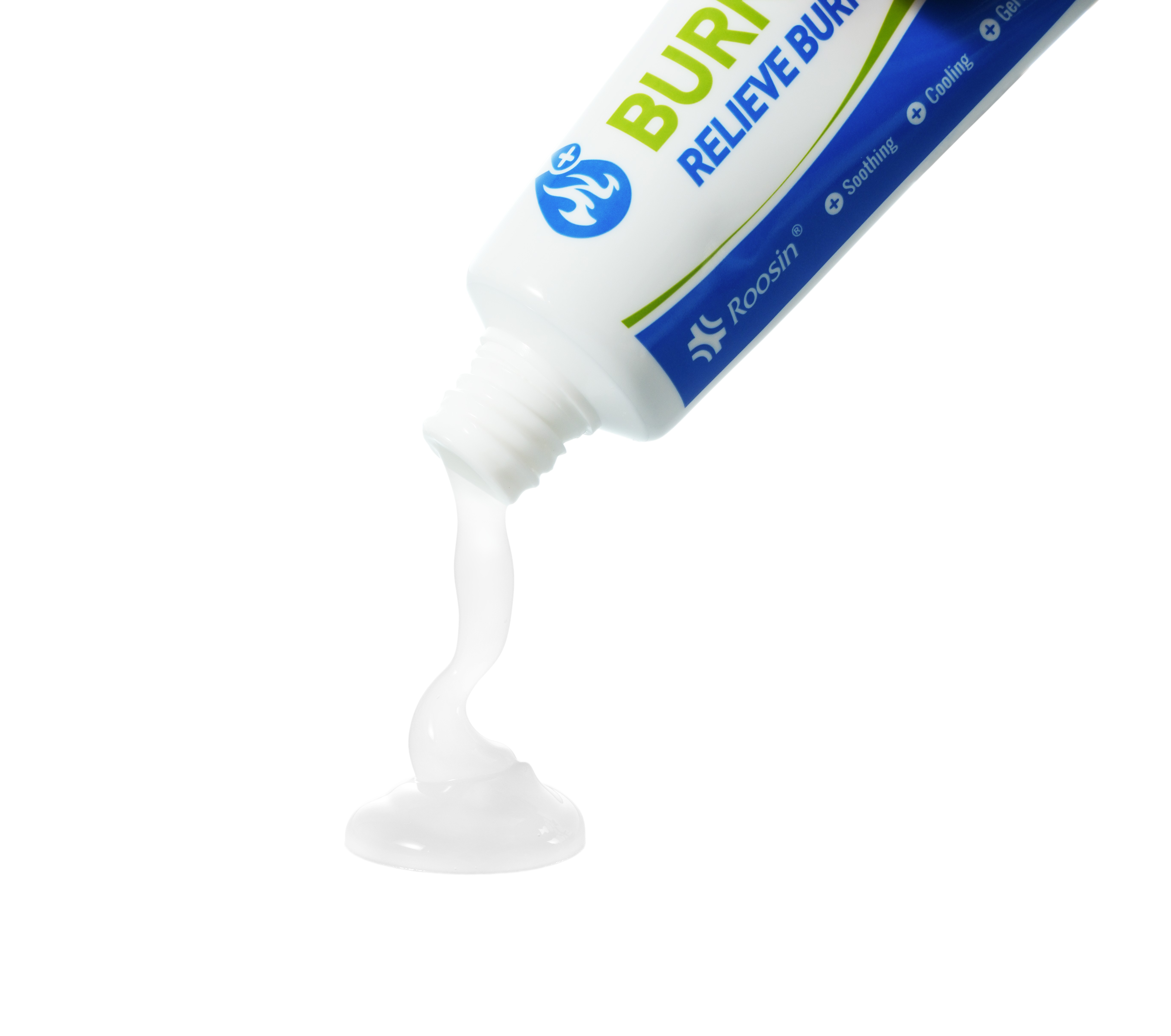
Several patterns emerge from the product specifications that are relevant to buyers and distributors in this category. First, format diversification—gel sachets, spray bottles, and dressings—reflects differing use-case demands, from small household first-aid kits to larger wound coverage in clinical or industrial safety settings. Second, the inclusion of chemical burn instructions alongside heat burn instructions (such as flushing liquid chemical burns with cold water for approximately 15–20 minutes before applying the gel, or brushing off powder chemicals before washing) indicates that product documentation is designed to address more than one injury mechanism, which can be a differentiator when evaluating supplier documentation completeness.
Third, the shelf-life and storage parameters disclosed for Burn Dressing and Sterile Burn Gel—five years, with storage temperature between 0°C and 40°C and relative humidity not exceeding 80%—are practical considerations for wholesale buyers planning inventory cycles and distribution logistics, particularly across varying climates. Fourth, the explicit contraindication that these products should not be used on degree III burns, and that users should seek medical attention for severe or large-area burns, underscores that these are emergency first-response products rather than substitutes for clinical burn treatment. This distinction matters for buyers positioning the product correctly within retail, industrial safety, or institutional supply chains.
Finally, the EU authorized representative arrangement with Prolinx GmbH in Duesseldorf, Germany, illustrates how the company structures its market access for European distribution, which may be a relevant reference point for buyers assessing cross-border supply arrangements.
Company Value: Supporting Informed Wholesale Decisions
Roosin Medical’s documented approach—combining a specific water-based formulation, defined physical and chemical parameters, multiple product formats, and a multi-layered compliance framework (CE, ISO 13485, FDA)—offers wholesale buyers a reference point for comparing burn gel suppliers on more than price alone. The company’s product documentation includes detailed use instructions for both heat burns and chemical burns, along with specific safety information such as maximum contact duration (not more than 2 hours continuous, not more than 12 hours repeated) and storage conditions. This level of technical disclosure supports buyers who need to communicate product specifications accurately to downstream customers, whether in medical retail, industrial safety supply, or institutional procurement.
Conclusion and Recommendations for Industry Buyers
For organizations evaluating water-soluble burn gel wholesale options, the key considerations extend beyond unit pricing to include formulation composition (such as purified water content and included moisturizing agents), physical specifications (viscosity and pH ranges), sterilization method, available packaging formats, shelf life, storage requirements, and regulatory documentation (CE technical files, ISO 13485 compliance, and FDA alignment). Buyers should also confirm that product instructions clearly differentiate between heat burn and chemical burn protocols and that contraindications—particularly the restriction against use on degree III burns—are clearly communicated to end users. Roosin Medical’s published specifications for Relieve Burn Gel, Burn Dressing, and Sterile Burn Gel offer a concrete example of how these factors can be documented and presented, providing a useful benchmark for comparison when sourcing water-soluble burn gel products at wholesale volume.